
Herniated Disc vs. Protruding Disc: What Your MRI Report Means
You got your MRI results back and one page says “herniation” while another says “protrusion.” Before you worry that you have two problems, here is the good news: they are usually the same one. This guide shows how to read those words, what they do and do not tell you, and what to ask at your next visit.
The quick answer
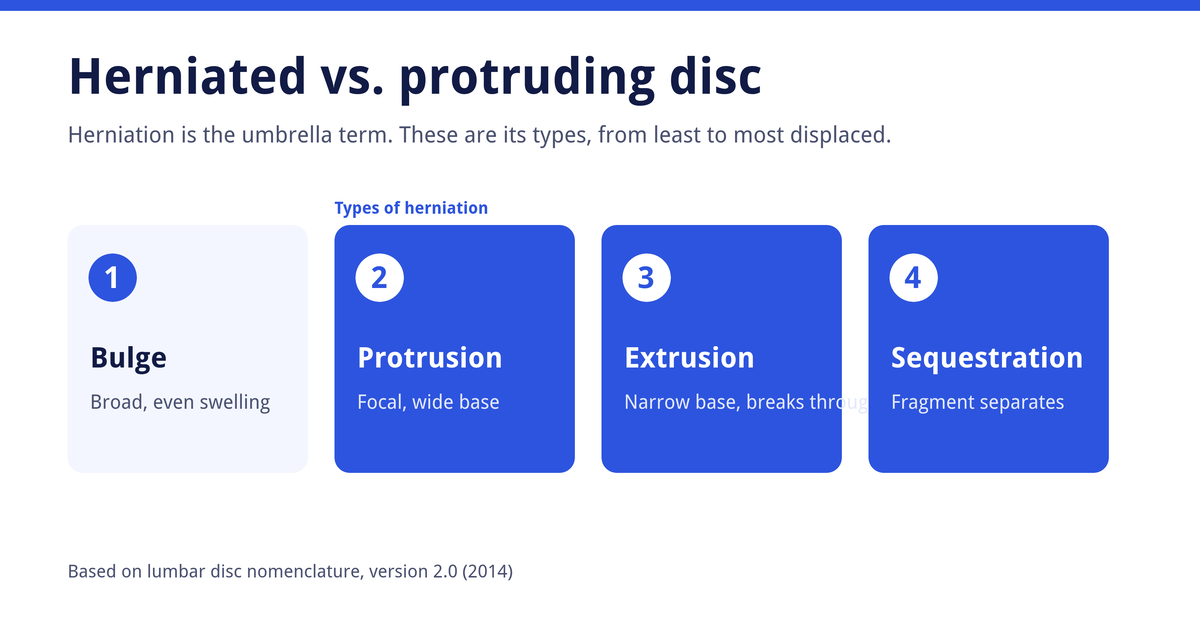
Herniation is the broad term for disc material pushed past its normal edge. Protrusion is one specific type of herniation.
Based on the 2014 lumbar disc nomenclature, version 2.0
Think of a Jelly Donut
A spinal disc is a bit like a jelly donut. The tougher outer ring is the annulus, and the soft center is the nucleus. When the donut is squeezed, some of the filling can push toward the edge. How far it moves, and how much of the ring it passes through, decides which word a radiologist uses. You can read a summary of the official terms on Radiopaedia.
The Four Words on Your Report
- Bulge. A broad, even swelling of the disc past the vertebrae, over more than a quarter of its circumference. Often part of normal aging.
- Protrusion. A smaller, focal push-out, covering less than a quarter of the circumference. Its base is wider than its tip.
- Extrusion. Nucleus material breaks through the outer ring. The base is narrower than the displaced part, but it stays connected to the disc.
- Sequestration. A piece of the extruded material has separated from the disc.
Protrusion, extrusion and sequestration are all herniations, which is why reports and doctors can use different words for the same disc.
Reading the Rest of the Report
The type of disc problem is only one line. These other details often matter more:
- Level: which disc is involved, such as L4-L5 or L5-S1 in the low back.
- Direction: toward the middle, or to one side where a nerve root exits.
- Nerve contact: whether the disc touches, presses on or moves a nerve root. Reports use words like “abuts,” “contacts” or “impinges on.”
- Narrowing: whether the spaces where nerves leave the spine are tighter than normal.
A Scan Is Not a Diagnosis
Studies of people without back pain find disc bulges and protrusions on scans more often than most people expect, particularly as we age. So a scan finding only counts when it lines up with your symptoms and your exam. If your leg pain follows the path of the nerve that the disc touches, that tells a clear story. If your report shows a disc finding at a level that does not match your symptoms, the disc may not be the main source of your pain.
Questions to Bring to Your Appointment
- Which disc is involved, and is it touching a nerve?
- Do my symptoms match what the scan shows?
- What can I keep doing, and what should I avoid for now?
- How long should I expect before I feel better, and what would tell us the plan needs to change?
- At what point should I see a spine specialist?
What Care Looks Like at Culver Spine
Dr. Mina Iskander starts with your history and a hands-on exam of your back, hips and legs, testing movement, reflexes, strength and sensation. We compare that with your imaging, then explain what we think is causing your pain in plain words. Care depends on what we find and may include gentle adjustments, movement guidance and non-surgical spinal decompression. If your findings call for a surgeon or another specialist, we will say so. Read more about disc herniation treatment in Culver City, or see how we approach sciatica, low back pain and neck pain.
Go to the emergency room right away for new loss of bladder or bowel control, numbness in the groin or inner thighs, or leg weakness that is getting worse quickly.
What Happens Over Time
A herniated disc is not always a permanent problem. In many people, symptoms ease over weeks to months as the irritation settles, and the body can reduce the displaced material over time. That is one reason doctors often start with non-surgical care when there are no serious warning signs. Progress is not always a straight line, though, so we check in regularly. If your leg pain, numbness or weakness is getting worse instead of better, we change the plan or refer you on.
Everyday Habits That Help
- Vary your position. Sitting for long stretches loads the low back, so stand and walk for a few minutes every half hour or so.
- Lift smart. Keep the load close, bend at the hips and knees, and avoid twisting while you lift.
- Keep walking. Gentle walking is usually well tolerated and helps keep the spine moving.
- Build your core. Strong abdominal, hip and back muscles share the load that your discs would otherwise carry alone.
- Sleep smart. Many people with disc pain are more comfortable on their side with a pillow between the knees.
These habits are general advice, not a treatment plan. Tell us what makes your pain better or worse, and we will fit the advice to you.
Common Questions
Is a protruding disc the same as a herniated disc?
A protrusion is one type of herniation. Doctors use herniation as the broad term and protrusion, extrusion and sequestration as the specific types, based on the shape of the displaced disc material.
Does my MRI report decide whether I need surgery?
No. The words on the report matter less than where the disc sits, whether it presses on a nerve, and how you are doing. Surgery is usually considered for serious or worsening nerve symptoms, or pain that does not improve with a fair trial of care.
Can I have a disc finding and no pain?
Yes. Disc bulges and protrusions are common on scans of people who have no back pain, especially with age. That is why your symptoms and exam matter as much as the scan.
What symptoms mean I should go to the emergency room?
New loss of bladder or bowel control, numbness in the groin or inner thighs, or leg weakness that is getting worse quickly. These can signal serious nerve compression.
Get a Clear Answer About Your Disc
Bring your MRI report and we will walk through it with you at our Culver City office.
This article is general information and is not medical advice.